Molta Vida, placemaking en Barcelona
(ENGLISH BELOW)
¿Qué significa escuchar?
¿Con qué parte del cuerpo escuchamos? ¿Orejas?
Y los que no pueden oír, ¿con los ojos?
Y los que no pueden ver, ¿con el tacto?
Have unos meses, en las calles del barrio Can Vidales, Barcelona, escuché durante 4 horas, a un barrio entero.
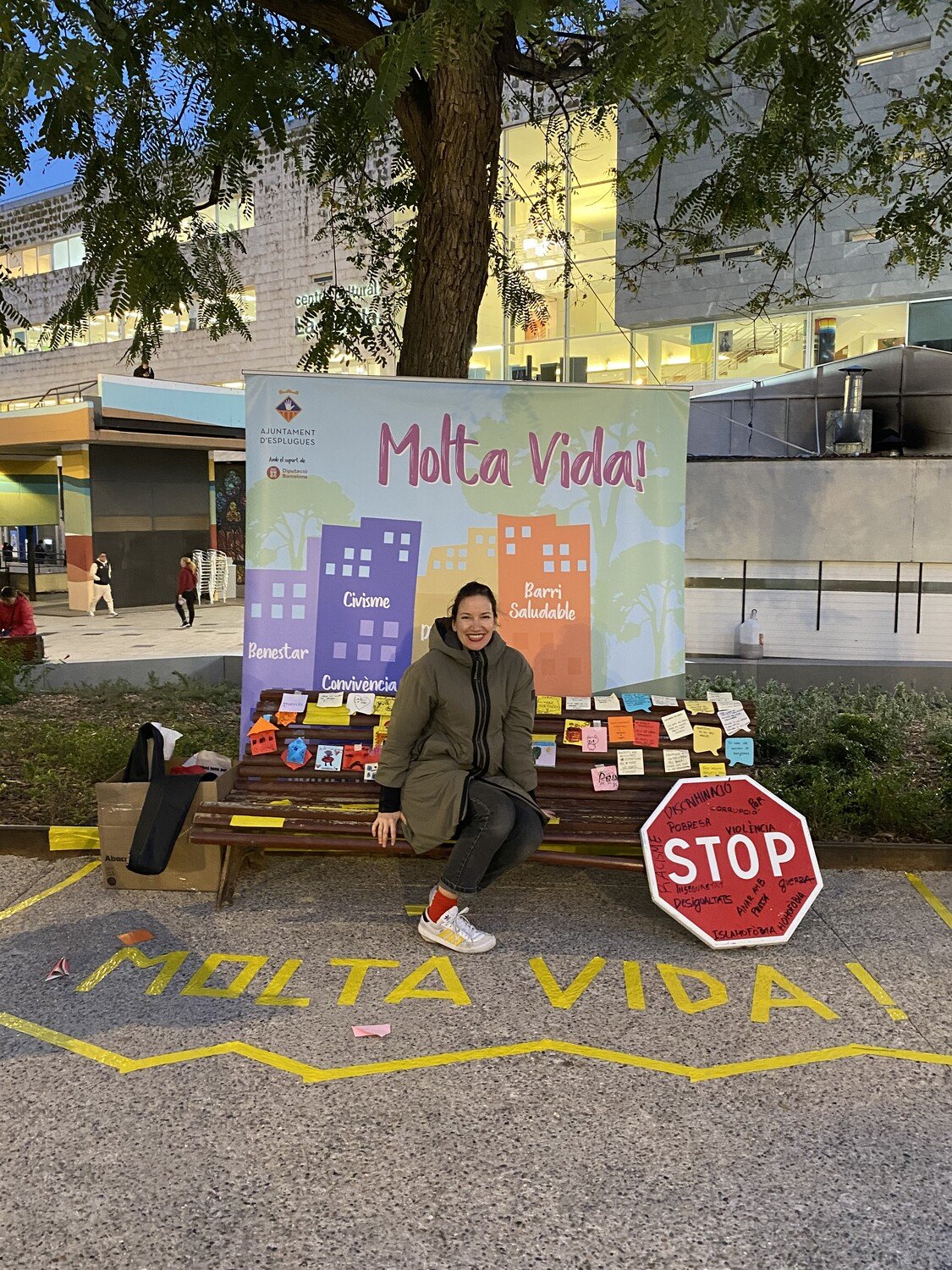
Escuché con todos los sentidos, escribí todas las palabras que recibí de la gente, de adultos, de niños, de migrantes, de madres, de hijas, de adolescentes curiosos…y cuando se acabaron las palabras, escuché con el corazón.
Escuchar con el corazón, para mi, es el tipo de escucha más profunda, y la más difícil a la que podemos acceder. El corazón suele estar cubierto por el cerebro, lleno de juicios y prejuicios. Pensamos conocer ya las respuestas de los demás, como se pudieramos imaginar sus vidas, aun sin saber absolutamente nada de ellas. Cuando decido escuchar con el corazón - porque es una decisión - me siento como una guerrera que se suelta el cinturón y abandona todas sus armas en el suelo. No quiero ganar nada. Quiero entender al otro. Y así, sin nada, lo más humilde que puedo, escucho.
Cuando estábamos preparando el evento, con las personas del Ayuntamiento que me contrató, estuvimos pensando en qué preguntas queremos hacer a la gente?
Ese proyecto tiene un lema: “Molta Vida!”, y otro, que pensamos ayer mismo “cedemos el paso a la convivencia”. ¿Y porqué deberíamos?
Porque en nuestras nuevas ciudades, de piedras y plazas antiguas, conviven generaciones de edades y culturas muy diferentes. Y si hay algo que no funciona, siempre es culpa del “otro”.
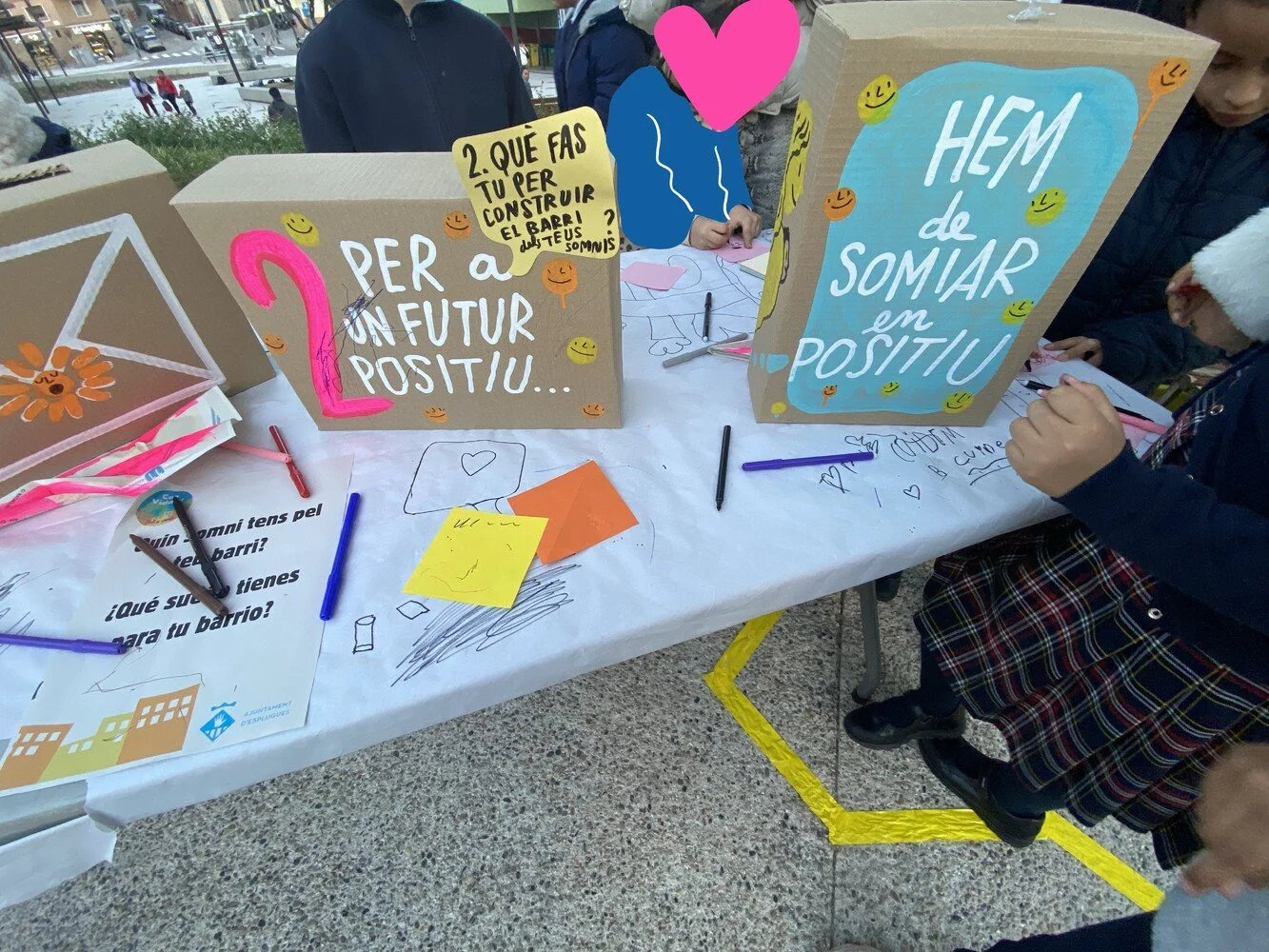
Preguntar a las personas lo que imaginan y sueñan, escucharles sin prisa, y hacerlo en su barrio, esto también es placemaking.
Preguntamos:
“¿Cómo sería el barrio de tus sueños?
y
¿Qué haces tú para crear el barrio de tus sueños?
La segunda pregunta pone un espejo delante de una y uno. Nos dijeron “quiero un barrio como el de antes, donde nos conocemos todos…pero…¿cómo participas tu en este barrio? Muchos no tenían respuestas, no podían pensar en soluciones basadas en la proactividad individual.
Y a ver, es verdad, hay cosas que no son fáciles de cambiar. Problemas sistémicos poco manejables por el individuo.
Los robos, los borrachos que hacen ruido de noche, la gente que tira toda su basura en las esquinas de las calles por comodidad…¿sigo? Seguro que cualquier persona que está leyendo esto y vive en una gran ciudad, ve escenas similares muy a menudo. Individualmente, no podemos arreglarlo todo.
Pero sí, podemos hacer algo. Podemos decir “buenos días” a todas las personas que encontramos en los primeros 20 minutos al salir a la calle por la mañana. Eso es fácil. Para probar. Ayer lo hicimos, durante nuestro recorrido de la oficina al lugar de escucha callejera. Y recibimos muchos “buenos días” de vuelta, a veces con una sonrisa agradecida. Dijimos “buen año nuevo” a la mujer china que lleva una tienda en una calle del barrio, y como por magia, su sonrisa iluminó toda la tienda. Imposible no darse cuenta de que una conexión tan simple pudo cambiar la cara de una persona.
Un buenos días puede acortar las distancia, puede hacernos sentir más unidos, provoca un calorcito en el corazón que no puedo explicar, pero lo puedo sentir.
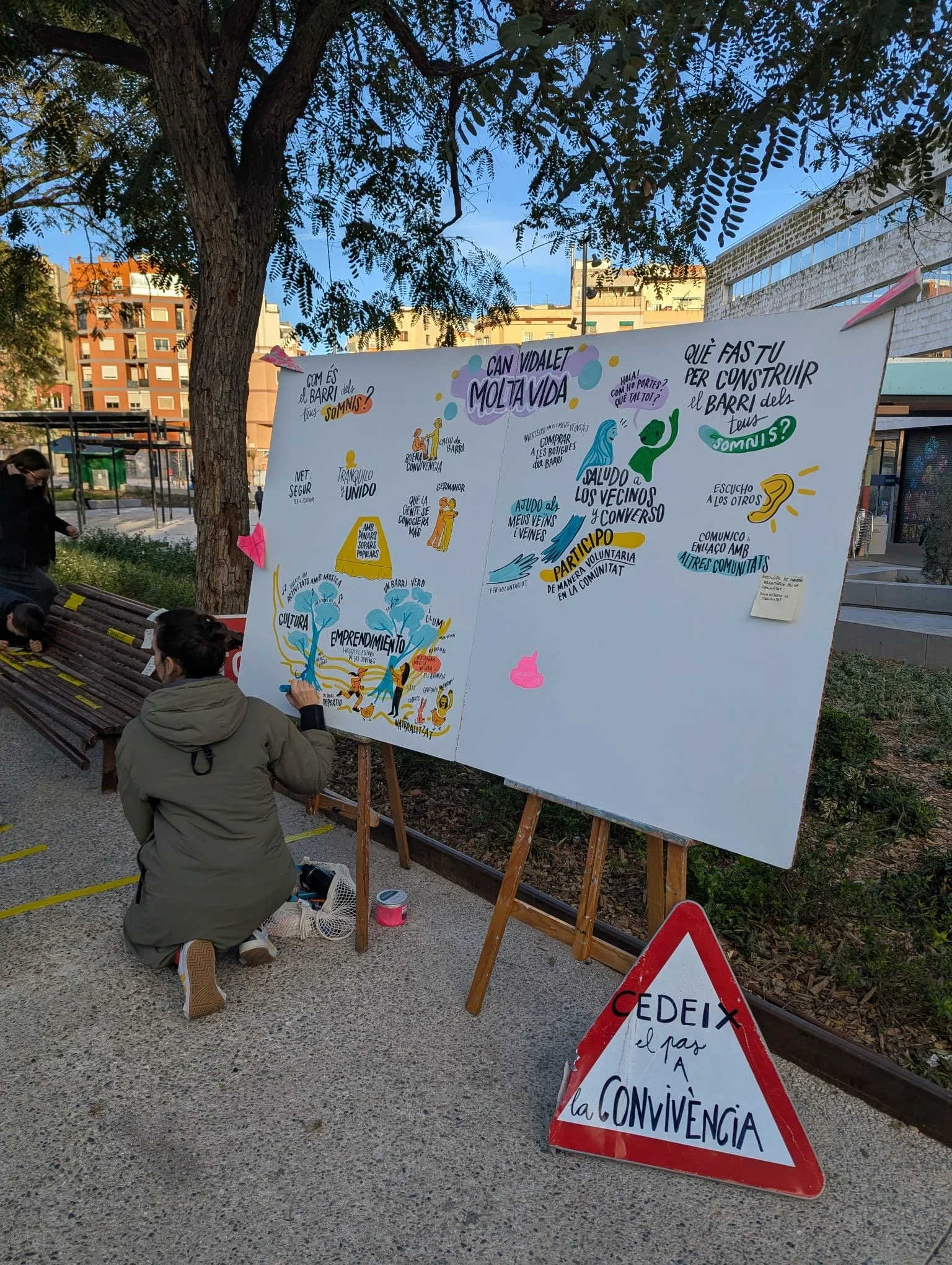
A media tarde el panel estaba…medio lleno. Lo llenamos todo!
¿Lo mejor de ayer?
Los niños y las niñas. Se me acercaron muchos, pidiendo “¿podemos dibujar también nosotros?”. Pues claro. Les dejamos una mesa con papeles y rotuladores, y la maravilla de respuestas que nos dieron…queremos conejos, gallinas, mariposas, mariquitas…queremos arboles, luz, música, queremos salir a la calle sin tener miedo. Queremos naturaleza salvaje. No lo dijeron, lo escuché con el corazón. Queremos un barrio limpio, respeto y amor para todas las familias, para todas las personas. Queremos hermandad. Queremos amor.
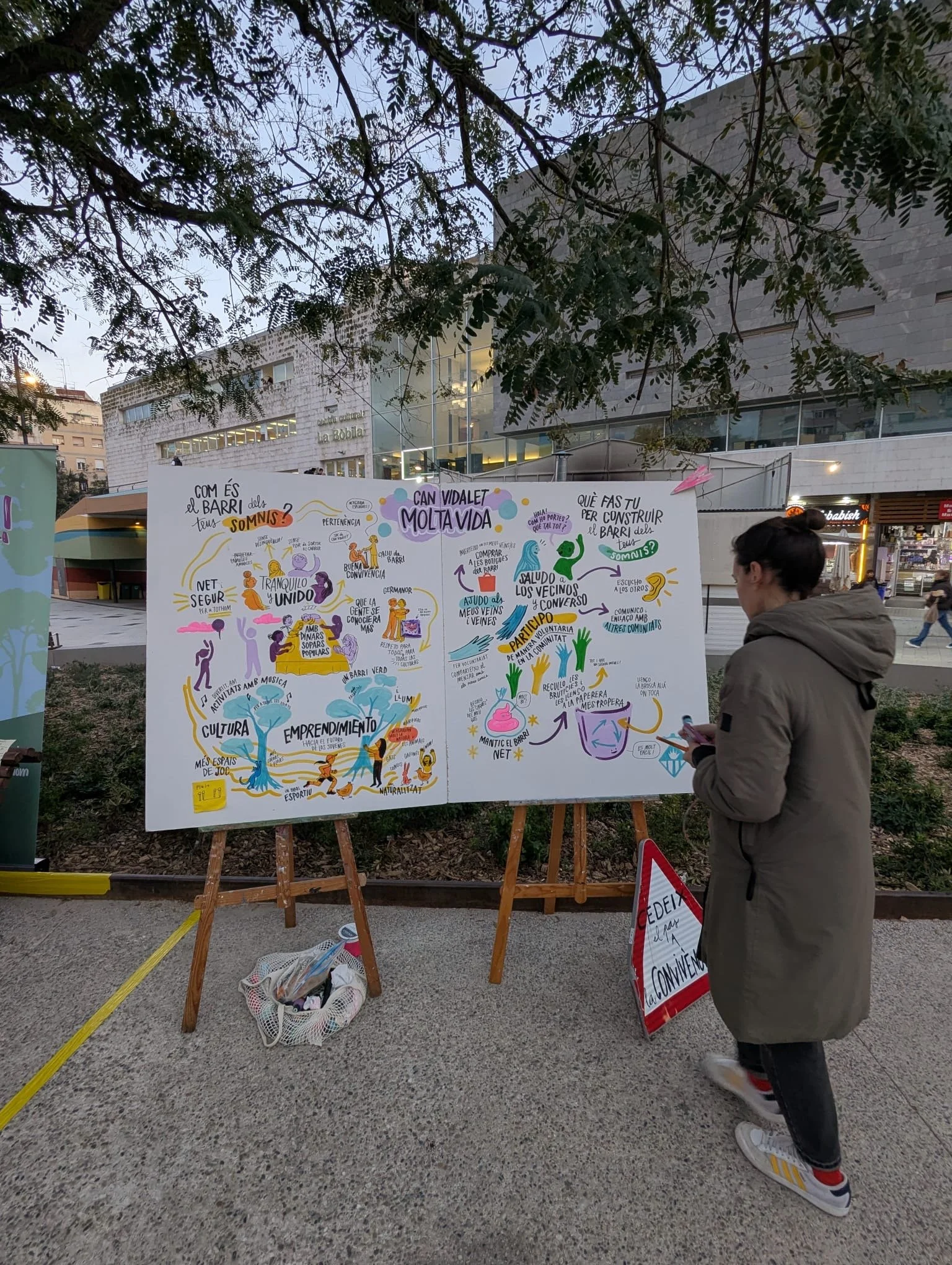
Molta Vida - el panel co-creado con las vecinas y los vecinos de Can Vidalet, y dibujado por Carlotta Cat.
Eso es lo que quiere el barrió que escuché. Y ha sido el mejor día de 2026, de momento.
**** ENGLISH****
Molta Vida!
What does it mean to listen?
With what part of the body do we listen? Ears?
And those who cannot hear, with their eyes?
And those who cannot see, with their sense of touch?
Yesterday, on the street, for four hours, I listened to an entire neighborhood.
I listened with all my senses, I wrote down all the words I received from people—adults, children, migrants, mothers, daughters, curious teenagers…and when words ran out, I listened with my heart.
Listening with the heart, for me, is the deepest kind of listening, and the most difficult to access. The heart is usually covered by the brain, full of judgments and prejudices. We think we already know other people's answers, as if we could imagine their lives, even without knowing absolutely anything about them. When I decide to listen with my heart—because it is a decision—I feel like a warrior who loosens her belt and lays all her weapons on the ground. I don't want to win anything. I want to understand the Other. And so, with nothing, as humbly as I can, I listen.
When we were preparing the event, with the people from the City Council who hired me, we were thinking about what questions we wanted to ask people.
This project has a motto: “Molta Vida!” (Long Live!), and another, which we came up with just yesterday: “We give way to coexistence.” Why?
Because in our new cities, made of stones and old squares, generations of very different ages and cultures live together. And if something isn't working, it's always the fault of “the other.”
We asked:
“What would your dream neighborhood be like?”
and
“What do you do to create your dream neighborhood?”
The second question holds a mirror up to everyone. They told us, “I want a neighborhood like the ones from before, where we all know each other…but…how do you participate in this neighborhood?” Many had no answers; they couldn't think of solutions based on individual proactivity.
And look, it's true, some things aren't easy to change. Systemic problems that are difficult for individuals to manage.
Thefts, drunks making noise at night, people who dump all their trash on street corners for convenience… shall I go on? I'm sure anyone reading this who lives in a big city sees similar scenes very often. Individually, we can't fix a lot.
But still, we can do something. We can say “good morning” to everyone we meet in the first 20 minutes of our morning outing. That's easy. Try it. Yesterday we did, during our walk from the office to our street listening post. And we received many “good mornings” in return, sometimes with a grateful smile. We said “Happy New Year” to the Chinese woman who runs a shop on a street in the neighborhood, and as if by magic, her smile lit up the whole shop. It was impossible not to notice that such a simple connection could change a person's face.
A simple "good morning" can shorten distances, can make us feel closer, can bring a warmth to the heart that I can't explain, but I can feel it.
The best part of yesterday?
The children. Many of them came up to me, asking, "Can we draw too?" Of course. We set up a table with paper and markers, and the wonderful answers they gave us... we want rabbits, chickens, butterflies, ladybugs... “we want trees, light, music, we want to go outside without being afraid”. It’s not about wanting animals, they want wild NATURE! “We want a clean neighborhood, respect and love for all families, for all people. We want brotherhood/sisterhood”. They want love.
That's what that neighborhood wants, as I heard yesterday. Best day of 2026, so far.